
The missing conversation about red light masks
The science may be exciting, but the marketing is outpacing our biology.

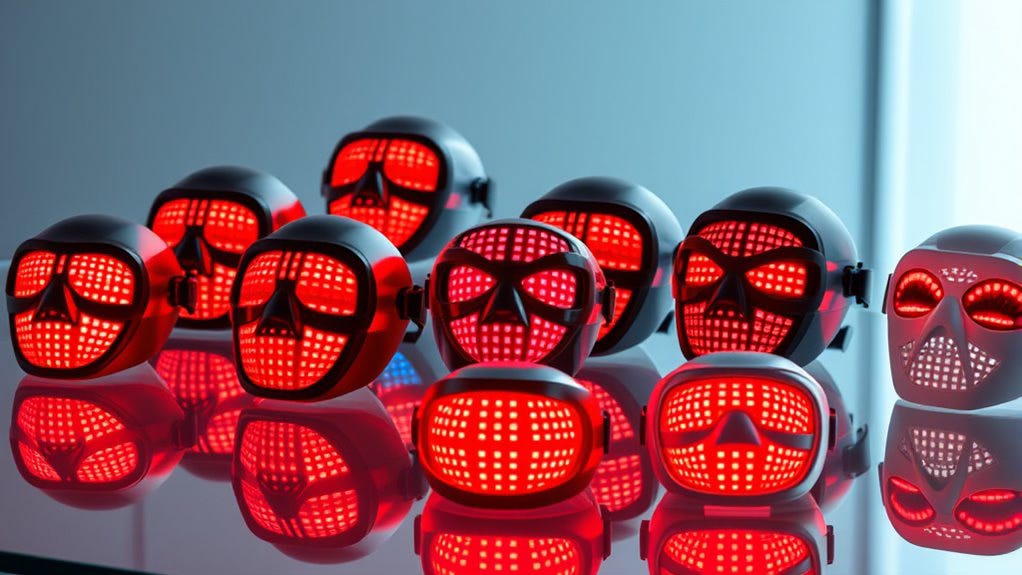
Today I was reminded by a patient, who reported developing a migraine after using a red light mask, that I wanted to finally share my thoughts on these devices, because I keep hearing similar stories in different forms. Also, there is not a week that goes by where someone doesn’t ask me what I think of them.
I’ve now had around ten reports from clients and friends, or individuals I’ve met in passing describing what they feel are meaningful side effects from red light masks.
So upfront, I’m going to share how I currently feel about them, what people have reported to me, and my thoughts on possible mechanisms. But before we even get into mechanisms, it’s worth zooming out.
The question is not simply whether red light “works,” but when, how, how much, and for whom, and under what level of standardisation and oversight these devices are actually being used.
As I am sure everyone can appreciate, most consumer red light masks sit in a very different category to clinically supervised photobiomodulation devices. So just because a device has been “FDA cleared” or CE marked, it does not mean they have been approved as safe and effective treatment devices, just that they are considered broadly similar to existing devices already on the market.
That distinction matters, because it means we are not always dealing with tightly controlled medical interventions, but rather a rapidly expanding consumer technology class with variable levels of independent testing, dose calibration, and real-world usage guidance.
In parallel, quality and manufacturing standards can vary significantly across the global supply chain. Some devices are rigorously tested with third-party verification of wavelength output and irradiance, while others rely primarily on internal specifications and marketing claims.
What is still largely missing is consistent, peer-reviewed, device-specific clinical data under real-world conditions of repeated home use, particularly for facial application over long periods of time.
So when people report very different outcomes, from benefit to overstimulation, it may not simply be a question of whether red light “works,” but, dose, timing, device quality, and individual sensitivity.
Personally, I find these masks somewhat unsettling, though that is mostly due to their appearance. There is something eerie about them, the way people wearing them appear almost half human and half machine. Perhaps some of you understand where I’m coming from. But what I also don’t love is, how quickly we assume consumer technology is biologically neutral simply because it is new, convenient, or marketed as ‘therapeutic.’ Suddenly, ‘everyone is using it’ becomes a substitute for questioning whether constant exposure, at-home use, and commercial optimisation are actually aligned with human biology.
What I feel genuinely quite strongly about, is that people need to understand why red light is being used in the first place, and that it isn’t something invented in a lab and then suddenly “added” to human biology. It’s already there, it always has been. Simply put, red and near-infrared light are not new inventions, they are part of the natural light environment humans evolved under and are present in daylight throughout the entire day. At sunrise and sunset, these wavelengths become proportionally more prominent as shorter blue wavelengths scatter through the atmosphere, which is why the light appears warmer and redder to the eye.
And I think this is the bit that gets missed in all the excitement, we are not introducing something foreign to biology, we are trying to isolate and concentrate something that has always existed within a far more complex, rhythmic, and context-dependent system.
The point I keep coming back to is not that red light is “unnatural,” but that context matters. Dose, timing, proximity, and individual sensitivity all matter far more than most consumer devices acknowledge. That said, I am aware that it’s important not to throw the science out with the scepticism. I find the photobiomodulation research fascinating and important, but mostly because it highlights the importance of spending more time outside and in nature. Scientists such as Glen Jeffery (who I think would agree with me on the unknown side effects of unregulated face masks) have explored how specific wavelengths of red and near-infrared light may support mitochondrial function in ageing retinal cells, with potential downstream effects on vision and metabolic health, including glucose regulation; really meaningful findings.
So this is not an anti-light therapy argument, it’s an argument for nuance, dosage, and biological realism, especially if we are going to use concentrated red light devices on the face and skin.
So let’s look at the proposed mechanism.
Red and near-infrared light interact with mitochondria, particularly cytochrome c oxidase within the electron transport chain, which supports ATP production and cellular energy efficiency. In simple terms, light can act as a biological signal that influences mitochondrial performance and oxidative stress regulation. But biology is rarely linear. It does not respond to single inputs in isolation, and it certainly does not evolve around isolated wavelengths delivered in artificial intensity.
Human biology still expects the full spectrum of natural light, delivered in rhythmic patterns across the day. One wavelength may be beneficial in specific contexts, but more is not automatically better. Also, most biological systems operate on principles of hormesis, where a small, well-timed stimulus may be beneficial, but excessive or poorly timed exposure can create stress responses, dysregulation, or compensatory effects. This is where I think many consumer applications are currently oversimplifying the biology.
So with that in mind, here are some of the most common patterns that have been reported to me, along with possible explanations. And to be clear, these are observations and hypotheses, not definitive mechanisms.
Migraines, headaches, and pressure behind the eyes
Some individuals report migraines or headaches following use.
One possible explanation is that many LED-based masks use pulsed light, and even when the eyes are closed, the nervous system still detects flicker through retinal or trigeminal pathways. In sensitive individuals, this may contribute to sensory overstimulation.
I would say this is the most common side effect, more general headaches, not necessarily full blown migraines, but I think sensitive individuals with a history of headaches should probably avoid the masks. Maybe try a small dosage (say 2-3 minutes) of a tested red panels first.
Skin reactions: rashes, redness, irritation
Some people describe histamine-like skin responses including redness, itching, or heat.
Red light increases circulation and cellular signalling, which in some individuals particularly those with mast cell activation tendencies, rosacea, eczema, or compromised skin barriers, may be perceived as overstimulation rather than benefit. Remember, more stimulation is not always more healing.
I have had two Long Covid patients have these kinds of reactions to these masks, which makes sense as both had some form of MCAS and were still on the road to recovery.
Pigmentation changes
This is not widely discussed, but some individuals report changes in pigmentation or worsening of melasma.
Cells respond to intensity, duration, wavelength, and cumulative exposure. Even in the absence of UV, light is still a biological signal, and melanocyte activity can be influenced by inflammatory and signalling pathways in the skin.
Also, melasma is highly heat-sensitive, and even modest warming of the skin can activate melanocytes. Some researchers also suspect that melanocytes in melasma-prone skin may respond abnormally to visible light stimuli more generally, rather than to UV exposure alone. I have had one friend who responded terribly to the mask but she already had small amounts of melasma on both cheeks - she used both the red light (670nm) and the NIR (890nm).
Changes around filler or scar tissue
I have heard a small number of reports describing inflammation or firmness in areas containing dermal filler or scar tissue following repeated use.
One possible explanation is that red and near-infrared light influence fibroblast activity, collagen signalling, and tissue remodelling. In altered tissue environments, these signalling pathways may not always produce predictable outcomes.
One friend, after around three months of using a red light mask, has now developed small lumps beneath the skin, not visibly obvious, but noticeable to the touch, in the areas where she usually receives her yearly fillers.
This is an area that clearly needs more research.
Nervous system stimulation and sleep disruption
Some individuals report feeling wired, restless, or experiencing sleep disruption when using devices later in the day.
Remember, light is a timing signal, it influences cortisol, melatonin, circadian rhythm, and autonomic nervous system balance. Using intense artificial light at the wrong time of day may create a form of biological confusion, even if the light is marketed as restorative, that doesn’t mean that has to be used when we’re winding down. Ideally, it’s probably best practice to use it after sunset.
Closing thoughts
So the question is not simply whether red light “works,” but when, how, how much and which products we can genuinely trust. Currently, the simplest guidance I would offer is to trust transparency over marketing, and to only consider companies that are third-party tested, clearly specify dosing and wavelengths, and provide independently verified output data in line with regulatory safety standards like UKCA or CE marking. In practice, that means prioritising clinical-level transparency over vague wellness claims, and if that level of evidence and disclosure is not available, I would stay well away.
Companies that meet this remit and I have had dealings with are: BlockBlueLight, Bon Charge and BioLight. However, I know there are more, but do your research.
And much more importantly, remember we are rhythmic biological beings that evolved in direct relationship with natural light, darkness, seasonal variation, and environmental cycles. Which is also why I keep coming back to something much simpler, which is to consider saving your time and money and get up and watch sunrise, and also make time for sunset, because the mechanisms we are trying to recreate with devices are already embedded in the daily light cycle itself.
Sunrise has so many more benefits than any face mask could ever offer - it helps anchor circadian rhythm, supports the cortisol awakening response, signals metabolic activation, and sets the tone for energy regulation across the entire day. Sunset does the opposite, it helps downshift the nervous system, supports melatonin signalling, and prepares the body for restoration, repair, and sleep.
And when you really sit with that, it becomes harder not to ask what we are trying to replace, and whether the most powerful interventions are sometimes still the simplest ones, the ones that have been there all along, quietly governing biology in the background.
Anyway, I hope this post has been of some interest, and on another note, I’d genuinely love to know other people’s experiences with these masks, positive or negative, because we are still in the early stages of understanding how this intensity of red light on the face effects us long term.
And on the flip side, I’d also be interested in any experiences people have with consistent exposure to natural red light, sunrise and sunset, and whether they’ve noticed changes in sleep, mood, energy, or resilience over time. I’m gathering stories for my new book, The Light Fix, and I would genuinely love to hear what others have observed and experienced.